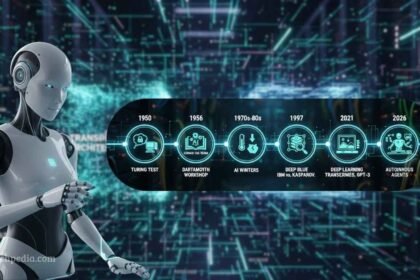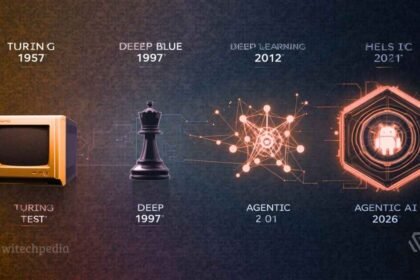



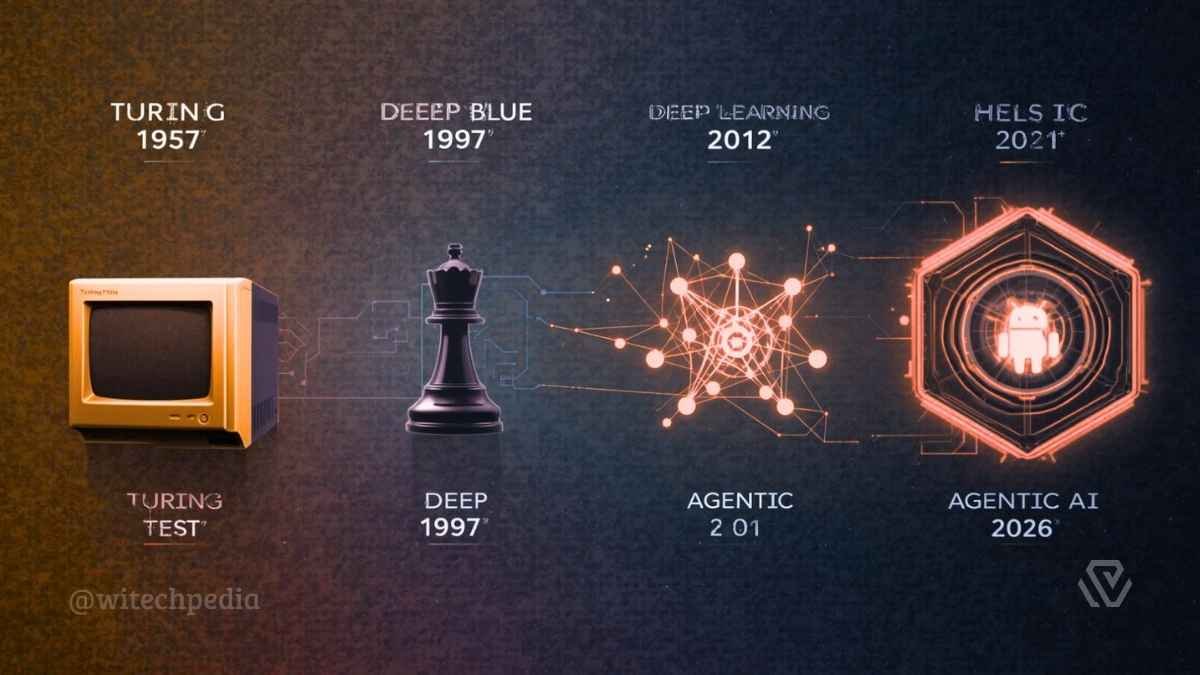
In 2026, we live in a world where AI agents write code, manage complex logistics, and generate photorealistic video in seconds. However, the history of artificial intelligence is not a straight line of success; it is a turbulent saga of high hopes, crushing failures (“AI Winters”), and exponential breakthroughs. To understand the powerful Agentic AI tools we use today, we must look back at the 70-year journey that transformed simple logic puzzles into the operating system of the modern web.
- The Early History of Artificial Intelligence: The Dawn of Thinking Machines (1950–1970)
- The AI Winters: Broken Promises and Funding Freezes (1974–1993)
- The Data Explosion and Machine Learning (1997–2011)
- The Deep Learning Revolution (2012–2021)
- Key Milestones in the History of Artificial Intelligence (2022–2026)
- Conclusion
The Early History of Artificial Intelligence: The Dawn of Thinking Machines (1950–1970)
The concept of “thinking machines” dates back to ancient Greek myths, but the scientific pursuit began in earnest following World War II.
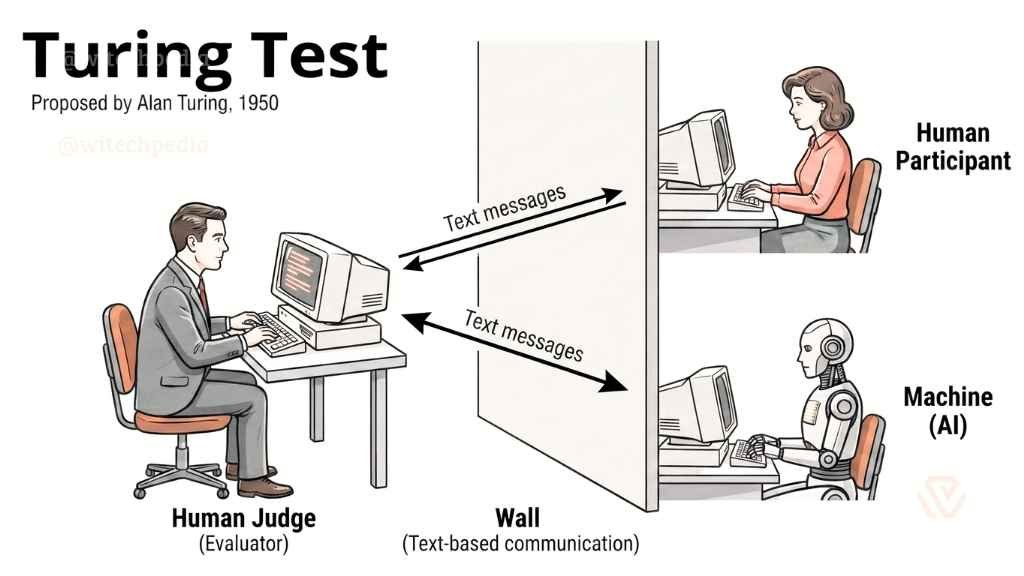
Alan Turing and The Imitation Game
In 1950, British mathematician Alan Turing published a landmark paper, Computing Machinery and Intelligence. He proposed a simple question: “Can machines think?” To answer this, he devised the Turing Test (originally called the Imitation Game). If a human judge could not distinguish between a machine and a human based on text-based conversation, the machine could be considered intelligent. This established the foundational goal for the next half-century of computer science.
The Dartmouth Conference (1956)
The term “Artificial Intelligence” was officially coined in 1956 at a summer workshop at Dartmouth College. Organized by John McCarthy and Marvin Minsky, this event is widely considered the birth of AI as an academic field. The attendees were optimistic, predicting that a machine as intelligent as a human would exist within a generation. You can read the original proposal for the Dartmouth Summer Research Project on AI to see just how ambitious they were.
ELIZA: The Illusion of Understanding
In 1966, Joseph Weizenbaum created ELIZA, one of the first chatbots. ELIZA mimicked a psychotherapist by using pattern matching and substitution logic. While it appeared to “understand” users, it had no concept of meaning—it was simply manipulating symbols. Despite this, many users formed emotional attachments to the program, a phenomenon now known as the “ELIZA Effect.”
The AI Winters: Broken Promises and Funding Freezes (1974–1993)
By the mid-1970s, the initial hype had worn off. Computers were simply not powerful enough to process the complex information required for true intelligence.
The Lighthill Report and the First Winter
In 1973, the Lighthill Report in the UK offered a scathing critique of AI research, concluding that the grand promises of the 1950s had failed to materialize. Governments in the US and UK slashed funding, leading to the first AI Winter—a period where research stagnated due to a lack of resources.
The Rise and Fall of Expert Systems
In the 1980s, AI saw a brief resurgence through Expert Systems. Unlike general intelligence, these programs were designed to solve specific problems by following thousands of “If-Then” rules derived from human experts (e.g., diagnosing blood infections or configuring computer orders).
- Success: Systems like XCON saved companies millions.
- Failure: They were “brittle.” If an input fell slightly outside the rules, the system crashed. Maintenance became too expensive, leading to a second AI Winter in the late 80s. See more on this era in our guide to Mainframes to Microchips: Computing History.
The Data Explosion and Machine Learning (1997–2011)
The resurgence of AI in the late 90s wasn’t driven by new logic, but by statistics and raw power.

Deep Blue vs. Kasparov (1997)
IBM’s Deep Blue became the first computer to defeat a reigning world chess champion, Garry Kasparov. However, Deep Blue wasn’t “thinking” in the human sense; it used brute-force computing to calculate 200 million positions per second. It proved that specific tasks could be solved through massive compute power.
The Statistical Shift
With the rise of the Internet (see our History of the Internet Timeline), researchers suddenly had access to massive datasets. AI shifted from “rule-based” approaches (telling the computer what to do) to Machine Learning (letting the computer learn from data). This era laid the groundwork for modern search engines and recommendation algorithms.
The Deep Learning Revolution (2012–2021)
This is the era where AI began to mimic the human brain’s architecture through Neural Networks.
ImageNet and AlexNet (2012)
For years, computers struggled to identify objects in photos. In 2012, a team led by Geoffrey Hinton used a Deep Convolutional Neural Network (CNN) called AlexNet to crush the competition in the ImageNet challenge. This proved that Deep Learning was viable, sparking a gold rush in GPU hardware.
AlphaGo and Intuition (2016)
While Chess is logical, the game of Go relies on intuition. In 2016, Google DeepMind’s AlphaGo defeated Lee Sedol, the world’s top Go player. AlphaGo famously played “Move 37,” a move so creative and unexpected that it suggested the AI had developed a form of creativity.
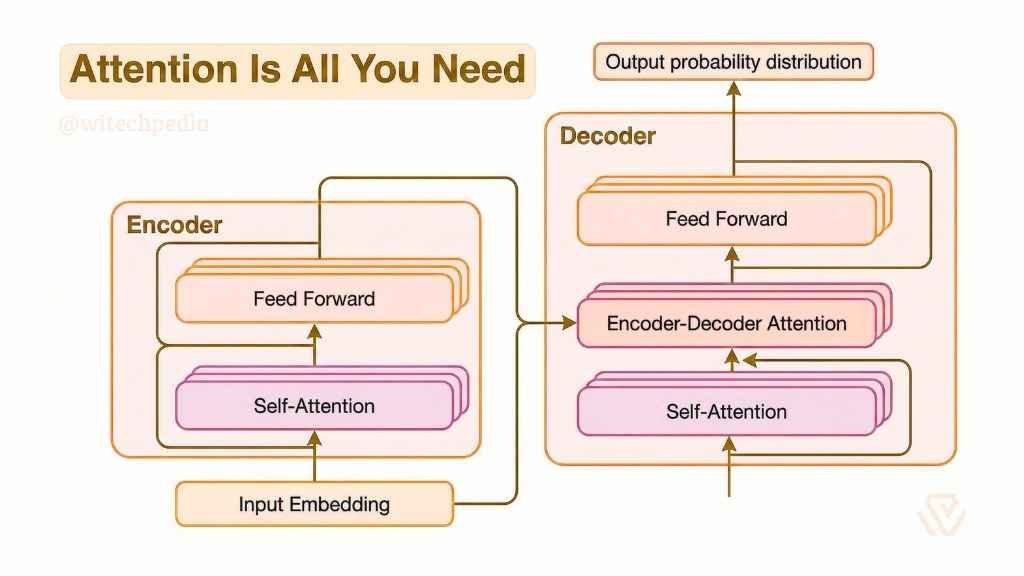
The Transformer: “Attention Is All You Need” (2017)
Google researchers published the “Attention Is All You Need” paper, introducing the Transformer architecture. Unlike previous models that read text sequentially (left to right), Transformers could pay “attention” to the relationship between all words in a sentence simultaneously. This architecture is the “T” in GPT (Generative Pre-trained Transformer) and the foundation of all modern LLMs.
Key Milestones in the History of Artificial Intelligence (2022–2026)
The modern era is defined by Generative AI and the transition to autonomous agents.
The ChatGPT Moment (2022)
OpenAI released ChatGPT, making Large Language Models (LLMs) accessible to the public. For the first time, AI passed the Turing Test for millions of users, capable of writing poetry, code, and essays with human-level fluency.
The Rise of Agentic AI (2025–2026)
By 2026, the focus shifted from “Chatbots” (which talk) to “Agents” (which do).
- Action-Oriented: Modern agents can browse the live web, execute code, and control other software tools.
- Reasoning Models: New architectures (like Chain-of-Thought processing) allow AI to “think” and plan before responding, reducing hallucinations and improving code generation.
- Physical AI: The integration of these “brains” into robot bodies is currently revolutionizing manufacturing and logistics.
Conclusion
From the simple pattern matching of ELIZA to the reasoning capabilities of 2026’s agentic models, the history of artificial intelligence is a testament to human persistence. We have moved from machines that could merely calculate to machines that can create, reason, and act.
As we look toward the future of AGI (Artificial General Intelligence), the most important skill for developers and users alike is learning to work alongside these systems.
Ready to implement these tools? Check out our reviews of the Best AI Tools for Developers in 2026 or learn how to secure your AI workflows in our Cybersecurity & Privacy section.